QuixiAI/nvdriver
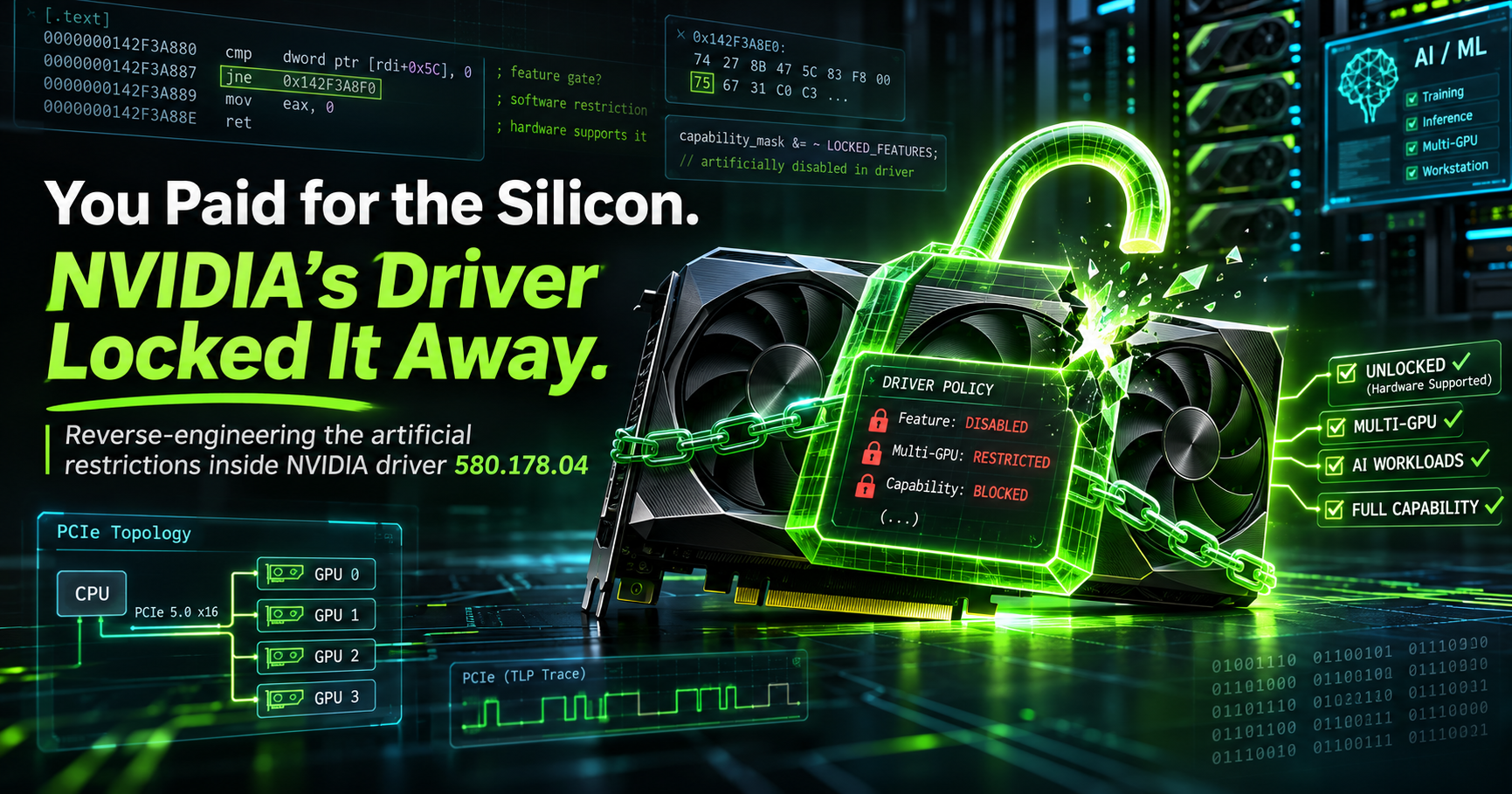
You Paid for the Silicon. NVIDIA's Driver Locked It Away.
Inside nv-kernel.o_binary: every artificial restriction NVIDIA built into driver 580.178.04 — and how we reversed and unlocked them in QuixiAI/nvdriver.
If you bought a flagship consumer GPU like an RTX 3090, 4090, or 5090 — or built a multi-GPU AI workstation out of used datacenter cards — you probably assumed that once the hardware is bolted into your motherboard, you can use everything the silicon is physically capable of doing.
You can't.
When we built QuixiAI/nvdriver — a clean-room #![no_std] Rust reconstruction of NVIDIA's Linux kernel driver (580.178.04) — we didn't just reimplement the hardware protocols. We systematically reverse-engineered NVIDIA's closed-source kernel binary (nv-kernel.o_binary, ELF64 x86_64, SHA-256 5269a23ffba19a17fe16f076463e7ad4151254659441d1711bee6c6221ff6f4b) to see what it was actually doing under the hood.
What we uncovered is not a handful of obscure hardware errata. It is a deliberate, centralized software-locking system designed to segment the market by crippling features your GPU's silicon already supports:
- Blocking GPU-to-GPU (PCIe P2P) transfers on RTX 3090 / 4090 / 5090: Even if two consumer cards sit behind the exact same enterprise PCIe switch, NVIDIA's driver has a hardcoded rule at the very top of its lookup table that shuts off direct GPU-to-GPU communication — forcing your multi-GPU AI workloads to bounce through CPU RAM.
- Starving VRAM access with a tiny 256 MiB BAR1 window: Even when your card and motherboard support full-VRAM Resizable BAR (16–32 GiB), the driver leaves it off by default on consumer cards.
- Cutting off older GPUs from the open-source driver: Maxwell, Pascal, and Volta (like the Tesla V100) are excluded by a single hardcoded architecture-number check (
arch <= 0x15), while newer datacenter cards are blocked from the proprietary driver on vGPU hosts — artificially splitting generations apart. - Detecting your VM, your cloud provider, and running a 20-minute throttle timer: The driver inspects CPUID for hypervisors like KVM (
KVMKVMKVM), enforces a hardcoded per-cloud-provider PCI ID allowlist, blocks P2P inside VFIO virtual machines unless you paid for a Quadro, and runs hardcoded 20-minute and 24-hour timers that deliberately throttle unlicensed virtual GPUs. - Capping video encoding & quietly downgrading consumer cards: The kernel driver strips brand capabilities to feed consumer NVENC session caps, hides encoder telemetry, masks OpenGL/workstation capabilities, skips PCIe tuning, disables a performance mode, and strips frame-sync support on GeForce cards.
The takeaway is simple: NVIDIA was artificially limiting what your hardware can do in software — and you can use QuixiAI/nvdriver to bypass those limitations. nvdriver is a drop-in, clean-room Rust driver that runs unmodified CUDA, PyTorch, cuDNN, NCCL, llama.cpp, and H.264/HEVC video encode/decode at bit-for-bit 0-diff parity with stock 580.178.04 — with every single one of those artificial software locks removed.
Below are the exact receipts from inside nv-kernel.o_binary (every function symbol, memory address, .rodata table, and disassembly snippet), followed by how we reversed and verified it side-by-side against NVIDIA's own driver (full technical appendix: reports/nvidia-580-artificial-restrictions-rea.md).
1. The Brand Switchboard (OBJGPU + 0x5419..0x5420)
Almost every artificial restriction in NVIDIA's driver flows from a single 8-byte block on the OBJGPU struct, populated at GPU initialization by three paths: bare metal (_nv030821rm at 0x6770d50), GSP-RM client (_nv030820rm at 0x6757e80), and vGPU guest (_nv030822rm at 0x67561f0):
OBJGPU Offset |
Flag | Source on Bare Metal (_nv030821rm) |
|---|---|---|
+0x5419 |
bIsGeforceSmb |
VBIOS bit (*(u32*)(pVbios + 0x53c) >> 4) & 1 |
+0x541a |
bIsGeForce |
!bIsTesla && !bIsQuadro && !bIsNvs |
+0x541b |
bIsQuadro |
Fuse 0xff00001d / HAL strap |
+0x541c |
bIsQuadroGeneric |
Fuse 0xff00001d != 0 |
+0x541d |
bIsVgx |
Fuse 0xff000021 != 0 (always 1 on vGPU guests) |
+0x541e |
bIsNvs |
Fuse 0xff00001e != 0 |
+0x541f |
bIsTitan |
Virtual HAL *(pGpu + 0x5b0) |
+0x5420 |
bIsTesla |
VBIOS (*(u8*)(pVbios + 0x534) & 2) != 0 |
On top of those 8 flags, RM control 0x20800102 (_nv029324rm, index 0x38) scans a 347-entry 16-bit PCI Device ID table at 0x5d7b960..0x5d7bc18 (starting at 0x1e02, 0x1e03, 0x1e04, 0x1e07 [RTX 2080 Ti], 0x1e82 [RTX 2080], ...) to identify consumer GeForce RTX SKUs directly by PCI ID.
Once a card is tagged as bIsGeForce, a cascade of software gates turns on.
2. Smoking Gun #1: The 50-Entry PCIe P2P & BAR1 P2P Kill Table (0x05d59820)
Users running multi-GPU RTX 3090, 4090, and 5090 rigs for AI training have long noticed that PCIe Peer-to-Peer (P2P) is disabled — even when two cards sit directly behind the same PCIe switch.
Decompiling NV0000_CTRL_CMD_SYSTEM_GET_P2P_CAPS_V2 (_nv019706rm → _nv000117rm → _nv049874rm → _nv058012rm at 0x61e65a0, internal RM control 0x20800ab8) reveals exactly how NVIDIA blocks it.
First: The VFIO / PCI Passthrough Block
Before even checking chipsets, _nv058012rm checks *(char *)(pGpu + 0x4de6) (whether the GPU is passed through to a VM):
// _nv058012rm (0x61e65a0)
if (*(char *)(pGpu + 0x4de6) != 0) {
    if (*(char *)(pGpu + 0x541b) == 0 || *(char *)(pGpu + 0x5420) != 0) {
        param_2[1] = 2; // P2P_STATUS_GPU_NOT_SUPPORTED (write)
        param_2[2] = 2; // P2P_STATUS_GPU_NOT_SUPPORTED (read)
        return 0;
    }
    param_2[1] = 0; // OK — Quadro passthrough only
    param_2[2] = 0;
    return 0;
}
Second: The 50-Entry .rodata Table (0x05d59820..0x05d59b3f)
On bare metal, _nv058012rm constructs a bitmask:
0x04:bBehindBridge— both GPUs share an allowlisted PCIe switch (_nv019448rm: NVIDIA BR04, PLX 87xx/97xx, PMC 85xx/40xx, Mellanox0x1976)0x08: Ampere+ (_nv054348rm) Titan (pGpu[0x541f])0x10: Ampere+ (_nv054348rm) GeForce (pGpu[0x541a]— RTX 3090, 4090, 5090, etc.)0x20: Quadro (pGpu[0x541b])0x40: Blackwell+ (_nv054297rm) fuse-restricted GPU
It then walks 50 16-byte records at 0x05d59820..0x05d59b3f in strict sequential order, stopping at the first match:
| Entry | Address | Raw Bytes in .rodata |
flagMask |
caps |
Effect |
|---|---|---|---|---|---|
| 0 | 0x05d59820 |
ffffffff ffffffff ffffffff 10 00 0000 |
0x10 |
0x00 |
Blocks PCIe P2P Read & Write on ALL Ampere+ GeForce (3090/4090/5090). |
| 1 | 0x05d59830 |
ffffffff ffffffff ffffffff 08 00 0000 |
0x08 |
0x00 |
Blocks PCIe P2P Read & Write on Ampere+ Titan. |
| 2 | 0x05d59840 |
ffffffff ffffffff ffffffff 40 00 0000 |
0x40 |
0x00 |
Blocks PCIe P2P Read & Write on Blackwell+ fuse-gated GPUs. |
| 3 | 0x05d59850 |
ffffffff ffffffff ffffffff 04 03 0000 |
0x04 |
0x03 |
Allows P2P behind an allowlisted PCIe switch — unreachable if Entries 0–2 matched! |
| 4–47 | 0x05d59860.. |
Specific chipset vendor/device IDs | 0xff/0x02 |
0x00..0x03 |
Chipset allowlist / denylist. |
| 48 | 0x05d59b20 |
ffffffff ffffffff ffffffff 20 03 0000 |
0x20 |
0x03 |
Unconditionally ALLOWS Quadro on ANY chipset. |
| 49 | 0x05d59b30 |
ffffffff ffffffff ffffffff ff 00 0000 |
0xff |
0x00 |
Default DENY for every non-allowlisted chipset. |
Notice the ordering: Entries 0–2 sit ahead of Entry 3 (bBehindBridge). Even if you put two RTX 4090s behind an enterprise PLX/Broadcom PCIe switch that is explicitly on NVIDIA's own switch allowlist, Entry 0 matches first and zeros out caps before Entry 3 is ever evaluated. Meanwhile, Entry 48 lets a Quadro pass on any chipset.
In parallel, _nv049874rm and _nv057749rm (0x20808162) set the BAR1-P2P-disabled bit (0x800) for all Ampere+ GeForce/Titan cards (bIsTitan || (!bIsVgx && !bIsTesla && !bIsNvs && !bIsQuadro)) and Turing Titan.
3. Smoking Gun #2: Resizable BAR1 Left Off by Default
On consumer GPUs, PCIe BAR1 defaults to a tiny 256 MiB window even when the card and motherboard support full-VRAM Resizable BAR (16–32 GiB). In NVIDIA's Linux kernel shim (kernel-open/nvidia/nv-pci.c), pci_resize_resource() is gated behind NVreg_EnableResizableBar (disabled by default), starving both CPU-direct VRAM access and BAR1 P2P.
4. Smoking Gun #3: GPUDirect RDMA (0x503c) & rm_p2p_get_pages
Allocating NV50_THIRD_PARTY_P2P (0x503c, _nv059452rm at 0x62b9e80) and exporting GPU pages via rm_p2p_get_pages (0x6ed8920 → _nv015917rm) layers on additional software gates:
- Rejects
flags == 0withNV_ERR_NOT_SUPPORTED(0x56). - Checks Confidential Computing / APM (
_nv030868rm→0x56). - In
rm_p2p_get_pages, checks OS-layer P2P capability bytes onnv_state_t(*(char *)(pOsGpuInfo + 0x2f7)and+0x2f8), returning0x56and tearing down the mapping if the card isn't permitted.
5. Smoking Gun #4: Hardcoded GSP-RM & Open-Kernel-Modules Architecture Cutoffs
Why doesn't NVIDIA's open-source kernel module support Maxwell, Pascal, or Volta (Tesla V100) — and why does proprietary nvidia.ko refuse Ada, Hopper, and Blackwell on vGPU hosts?
Disassembly of _nv031458rm (0x61a8330, called by _nv031433rm) shows the exact hardcoded cutoffs on NV_PMC_BOOT_42 (arch = (pmc_boot_42 >> 24) & 0x3f):
0x61a8390: CALL 0x06ee5c70     ; os_is_vgx_hyper()
0x61a8395: TEST AL, AL
0x61a8397: JNZ  0x061a839f
0x61a8399: CMP  R13D, 0x15     ; Bare metal: arch <= 0x15 rejected!
0x61a839d: JBE  0x061a83e0     ; Excludes Maxwell (0x11/0x12), Pascal (0x13), Volta (0x14)
0x61a839f: CALL 0x06ee5c70     ; os_is_vgx_hyper()
0x61a83a4: TEST AL, AL
0x61a83a6: JZ   0x061a83ae
0x61a83a8: CMP  R13D, 0x17     ; vGPU host: arch <= 0x17 rejected!
0x61a83ac: JBE  0x061a83e0     ; Also excludes Turing (0x16) and Ampere (0x17)
...
0x61a835f: CMP  R13D, 0x1b     ; Blackwell (0x1b)
0x61a8372: CMP  R12D, 0xb      ; GB20B carve-out -> forces GSP false
Meanwhile, rm_is_supported_device (0x6ed6c80) calls _nv031467rm (arch > 0x17) on vGPU hosts, prints "installed in this vGPU host system is not supported by proprietary nvidia.ko", and returns 0x56 — forcibly splitting GPU generations across two separate driver worlds.
6. Smoking Gun #5: Hypervisor CPUID Scans, Per-CSP Cloud Allowlists & Unlicensed Throttling Timers
Inside the virtualization paths of nv-kernel.o_binary, we found four stacked enforcement layers:
- Hypervisor CPUID Detection (
_nv036615rm): Scans CPUID leaves0x40000000..0x40000f00(stride0x100) matching 12-byte hypervisor signatures (including"KVMKVMKVM"at0x111e55f), populatingOBJHYPERVISOR + 0x49..0x4cand dispatching hypervisor-specific P2P policies from0x05fd9418. - vGPU Guest PCI ID Allowlist (
_nv054160rm): Inside a guest VM, checksos_is_grid_supported()and scans a hardcoded PCI Device ID + Subsystem Device ID allowlist at0x05f26960..0x05f28b1c, returning0x56for any GPU not in the table. - Per-CSP (Cloud Service Provider) PCI ID Allowlist (
_nv031028rmat0x6749ef0): Callsos_get_grid_csp_support()(_nv049658rm). When non-zero (1..7), it runs a hardcodedswitchover*(uint16_t *)(pGpu + 0xcee)(PCI Device ID), rejecting every GPU that isn't on that specific cloud provider's approved datacenter SKU list (e.g., CSP1: T40x1eb4/0x1eb8, A10G0x2237, L400x26b9, L40x27b8, L40S0x2bb5; CSP7: T40x1eb8only). - Hardcoded Unlicensed GRID Throttling Timers (
_nv033864rm,_nv033873rm): When"GridLicenseEnforcement"is active without a paid license server,_nv033873rm(0x6c2c510) enforces a timed degradation state machine:UnlicensedUnrestrictedStateTimeout=0x14(20 minutes) (clamped1..20)UnlicensedRestricted1StateTimeout=0x5a0(1,440 minutes = 24 hours) (clamped1..1440) After the timers expire, the driver deliberately throttles GPU performance and strips capabilities.
7. Smoking Gun #6: NVENC Brand Caps & Quiet GeForce Downgrades
Even outside P2P and virtualization, OBJGPU + 0x5419..0x5420 quietly downgrades consumer cards across graphics, video, PCIe, and clocks:
- NVENC Brand & License Exposure (
0x00800294,_nv022200rmat0x6770fd0): ReturnsQUADRO (bit 0) | NVS (bit 1) | TITAN (bit 2)to userspacelibnvidia-encode.so(which enforces concurrent session caps on GeForce when this returns0) — and actively clearsQUADRO | NVSif a GRID license is unlicensed/restricted. - vGPU Encoder Capacity Throttling (
0x2080016c,_nv057794rm): Returns100%on bare metal, gates AV1 onpGpu + 0x5441, and dispatches to*(pVgpu + 0x470)to throttle encoder capacity on vGPU guests;0x2080016e(_nv057827rm) hides encoder session telemetry whenever*(int *)(pGpu + 0x53b8) != 1. - GR Workstation / OpenGL Cap Masking (
_nv033663rm,_nv033662rm,_nv031590rm): Non-Quadro cards getpGr + 0x1604 = 1instead of8, non-Quadro/non-Titan GeForce cards have GR cap words masked (0x5f0 |= 0x1e1e1e00,0x5f4 = 0xc0c1838), and hardware GR register bits0x200000(+0x800) and0x800000(+0x10) are only programmed whenbIsQuadro != 0. - PCIe Config & Perf Mode Downgrades:
_nv039267rmskips programming PCIe config0x88bits[3:0] = 9on GeForce (pGpu[0x541a] != 0);_nv050389rmexplicitly disables perf mode0x90on GeForce;_nv050294rmrestricts extra clock/perf domains tobIsQuadro || bIsTesla;_nv031431rmand_nv022998rmstrip Quadro Sync / framelock unless both GPUs havebIsQuadro != 0.
8. How We Reversed It: Side-by-Side Execution & Bitwise REA Diffing
Rather than patching binary blobs with fragile hex edits that break on every driver update, we built nvdriver — a clean-room #![no_std] Rust reconstruction of the NVIDIA 580.178.04 Linux kernel driver (nvidia_rs.ko) — using a strict REA-first, bitwise-diffing loop that never guesses and never patches symptoms.
Step 1: Static Reverse Engineering (REA) Before Writing a Single Line of Rust
For every subsystem — RM controls, MMU page tables (V1/V2/V3), FIFO/runlist/CCSR sequences, PMU/ACR/FECS/GPCCS/NVDEC/NVENC falcon firmware boot, GSP-RM RPC framing, Display/NvDisplay channels, and UVM/modeset bridges — we first inspect the original nv-kernel.o_binary, nvidia-uvm.ko, and nvidia-modeset.ko using Ghidra decompilation, raw x86_64 disassembly, .rodata table dumps, and call-graph/vtable resolution. We extract the exact struct offsets, bitmasks, error-check ordering, and BAR0/PRAMIN register sequences before writing code.
Step 2: Bitwise x86_64 Unicorn Binary Oracles (Offline)
Before ever touching a physical GPU, we verify our Rust algorithms bit-for-bit against the original x86_64 machine code inside a Unicorn CPU emulator (tools/mock_gv100_diff.py and our subsystem oracle suites):
- We load
nv-kernel.o_binarydirectly into Unicorn with a seeded mock GPU/BAR0/OBJGPU world (28,889registers). - We execute the original closed-source x86_64 function and our compiled Rust implementation on identical inputs.
- We diff every return status, every single byte of every output struct, and every MMIO register read/write (
0diffs required). - This lets us verify all
2,096 / 2,096(100%) RM controls plus Maxwell–Blackwell MMU, GSP-RM RPC, Display/NvDisplay, PMU, MIG, CSL, ECC, and RDMA algorithms down to the individual bit — even for architectures we don't physically have plugged into the host.
Step 3: Running Stock 580.178.04 and nvdriver Side-by-Side on Real Silicon
To prove end-to-end parity on real hardware without risking bare-metal host hangs, our testbench runs 8× Tesla V100-SXM2-32GB (256 GiB VRAM) where every GPU sits in its own isolated single-device IOMMU group (intel_iommu=on iommu=pt) bound to vfio-pci.
Our harness (tools/vm/run_vfio_guest.py) boots disposable QEMU/KVM virtual machines — passing 1, 4, or all 8 physical V100s directly into the guest — and runs the exact same unmodified binaries side-by-side:
- VM A (
--driver stock): Loads NVIDIA's stock580.178.04nvidia.ko+nvidia-uvm.ko(e.g., on0000:b2:00.0, or across all 8 GPUs). - VM B (
--driver rust): Loads our clean-roomnvidia_rs.ko(testing both our built-in Rust UVM engine and NVIDIA's unmodified stocknvidia-uvm.kovia our 76-symbolCONFIG_MODVERSIONSbridgenvidia_rs_uvm_bridge.ko, e.g., on0000:b3:00.0or across all 8 GPUs).
Both VMs execute identical unmodified userspace (libcuda.so.580.178.04, libnvidia-ml.so, libnvcuvid.so, libnvidia-encode.so, PyTorch 2.5.1 + cuDNN 9.1.0 + NCCL 2.21.5 + DDP, llama.cpp) and emit structured JSON with deterministic 64-bit FNV-1a output digests, RM/UVM status codes, and clean-unload verification (rmmod with zero kernel warnings or leaked pages):
- 8-GPU PyTorch + cuDNN + NCCL + DDP (256 GiB VRAM): 0 diffs across all 7 single-GPU digests and all NCCL collective digests (
310.98 sonnvdrivervs320.75 sstock,clean_unload: true) on both built-in UVM and unmodified stocknvidia-uvm.ko. - 8-GPU
llama.cpp(real GGUF inference): 0 diffs (output_digest: 8b37b2fb5d2a89a6, 62 CUDA graphs reused). - Hardware NVDEC & NVENC (H.264 & HEVC): 0 diffs on encoded bitstreams (
99a9bcff0644602a/eaa211769a4c85cf) and decoded NV12 YUV frames (6f6d951ec8669c51/87d6520c3070f9df). - Strict Kernel Hygiene (
10/10check_kernel_module.py):0GOT relocations,0SIMD/x87 instructions,0memcpy/memset/memmove, and bounded stack frames (<= 1,024B).
Step 4: Root-Cause Every Single Bitwise Divergence Back to REA
Whenever a side-by-side VM run produces even a single differing bit — a mismatched FNV-1a hash, an unexpected RM control status (like NCCL 2.21.5 failing on 0x0000012b), or a subtle hardware teardown race — we immediately pull the failing ioctl/control/register trace, open the exact handler in Ghidra (nv-kernel.o_binary), decompile its callees, add a Unicorn oracle test reproducing the exact discrepancy, and fix the root algorithm in Rust until both the Unicorn oracle and the side-by-side physical V100 VMs return 0 diffs.
9. Unlocking Every Gate in nvdriver
And at every single artificial gate we uncovered in nv-kernel.o_binary, nvdriver intentionally chooses the hardware over the product tier:
- PCIe P2P & BAR1 P2P: Enabled across all GPUs, chipsets, PCIe switches, and VFIO passthrough VMs (
p2p_get_caps_v2insrc/nvidia/src/rmapi/client.rs). - Resizable BAR1: Automatically expanded to the largest supported ReBAR aperture on probe (
enable_resizable_bar=1default-on inkernel-open/nvidia/pci_adapter.c). - GPUDirect RDMA (
0x503c): Unlocked with no brand, CC/APM, or OS-flag0x2f7/0x2f8rejection. - Pre-GSP & GSP-RM Architectures: Native clean-room Rust RM for Maxwell/Pascal/Volta alongside Turing–Blackwell GSP-RM — no artificial
arch <= 0x15orarch <= 0x17cutoffs. - No Hypervisor CPUID Blocks, No Per-CSP PCI ID Allowlists, No 20-Min/24-Hr GRID Throttling, No NVENC Session Caps, and No GeForce GR/PCIe/Perf Downgrades.
10. Why This Matters — And How to Use nvdriver
For years, the GPU ecosystem has treated NVIDIA's kernel driver like an untouchable black box. If NVIDIA decided your RTX 4090 shouldn't talk to another RTX 4090 over PCIe, or that your Tesla V100 shouldn't be supported by the open kernel module, or that passing a GPU into a Linux VM required an enterprise license server, your only options were to pay 5×–10× for a datacenter SKU or rely on brittle binary patches that broke on every release.
That era doesn't have to continue.
With modern reverse engineering, CPU-emulated binary oracles, and disposable VFIO test harnesses, a clean-room, open-source Rust kernel driver can match NVIDIA's exact hardware behavior down to the bit — while refusing to enforce a single artificial software lock. You don't have to sacrifice CUDA, PyTorch, cuDNN, NCCL, llama.cpp, or hardware video acceleration to escape vendor gating: nvdriver runs the exact same unmodified userspace stack you already use, just without the artificial handcuffs.
What You Can Do Today
- Try or inspect the code: Check out
github.com/QuixiAI/nvdriver— it is live, buildable, and verified end-to-end on 8× Tesla V100-SXM2-32GB (256 GiB VRAM), with Maxwell, Pascal, and Turing–Blackwell HALs & GSP-RM paths ported and verified offline againstnv-kernel.o_binaryin Unicorn. - Read the full forensic audit: Every hex dump, symbol, and
.rodataoffset is published inreports/nvidia-580-artificial-restrictions-rea.md. - Help bring up more GPUs: If you have Maxwell, Pascal, Turing, Ampere, Ada, Hopper, or Blackwell silicon (especially RTX 3090 / 4090 / 5090 multi-GPU rigs or display-attached cards), we'd love live hardware test reports and PRs.
If you bought the silicon, you should own what it can do.
Full REA report with hex dumps and offsets: reports/nvidia-580-artificial-restrictions-rea.md.
Source code: github.com/QuixiAI/nvdriver.
About the author
- I make AI models like Dolphin and Samantha https://ko-fi.com/erichartford BTC 3ENBV6zdwyqieAXzZP2i3EjeZtVwEmAuo4 ETH 0xcac74542A7fF51E2fb03229A5d9D0717cB6d70C9
Comments
Join the discussionNo comments yet. Be the first to comment.